Monday, August 30, 2010

Cliffs of Moher

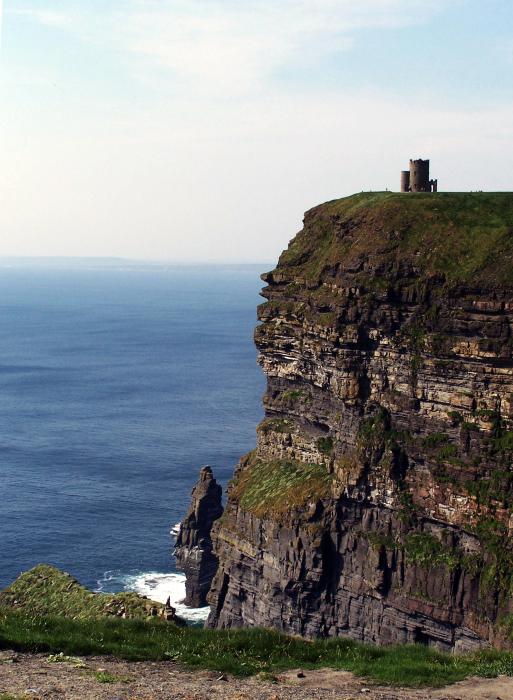
Cliffs of Moher, County Clare, Ireland
The Cliffs of Moher, in County Clare, are one of Ireland’s top Visitor attractions, with close to 1 million visitors per year. A visit to this majestic natural wonder and you’ll know why. The Cliffs stand 702 feet high at its highest point, stretching roughly 5 miles, offering breathtaking views of the beauty of Ireland’s west coast and the sheer power of the Atlantic Ocean. Even on a calm day, the great ocean waves ceaselessly pound the shore with white surf continually showing white surf at the base of the cliffs.

O'Brien's Tower is a round stone tower at the approximate midpoint of the cliffs. It was built by Sir Cornelius O'Brien, a descendant of Ireland's High King Brian Boru, in order to impress female visitors. O'Brien's Tower stands proudly on a headland of the majestic Cliffs. From the Cliffs one can see the Aran Islands, Galway Bay, as well as The Twelve Pins, the Maum Turk Mountains in Connemara and Loop Head to the South. The Cliffs of Moher take their name from a ruined promontory fort “Mothar” which was demolished during the Napoleonic wars to make room for a signal tower.

The exciting eco-friendly Visitor’s Centre offers an array of interactive media, exploring topics such as the origin of the Cliffs, the bird and the fish life, and others. The site has been developed by the Clare County Council to allow visitors to experience the Cliffs, without the distraction of overly-imposing man-made amenities and facilities. In keeping with this approach the “Cliffs of Moher Visitor Experience” is built into a hillside approaching the Cliffs, blending naturally with the surrounding countryside. The centre is environmentally sensitive in its use of renewable energy systems including geothermal heating and cooling, solar panels, and greywater recycling.

Thursday, August 26, 2010

Beehive Huts of the Dingle Peninsula

Beehive-huts, a type of Clochan, are dry-stone huts with a corbelled roof. These huts are believed to date from the 1100’s when Norman conquerors forced the Irish off the best land and out onto the far reaches of the Dingle Peninsula. They are commonly interpreted as the secular dwellings of Early Christian Monks. Having survived the test of time, these huts are available for viewing for small fees, usually around 1 Euro.

These stone structures are scattered around County Kerry, but there is a good concentration of them along the Slea Head Drive, on the Dingle Peninsula, Ireland. Several of them are linked together to form little compounds or communities, with walls to enclose livestock.

It is fascinating to walk through these structures and imagine making one of these huts your home. It must have been a rugged lifestyle, but perhaps the stunning views of the Atlantic Ocean were worth it.

Join Celtic Tours for a drive through the Dingle Peninsula to view these Beehive-huts on our Celtic Dream Premier Escorted Motorcoach Tour of Ireland. This amazing itinerary is available in 2 options 12 or 13 days! Other sights you will see along the way: Trinity College and the Book of Kells, Kilkenny Castle, Cobh Heritage Center, Blarney, Foynes Flying Boat Musuem, Cliffs of Moher, Rathbaun Farm, Galway Crystal Factory, Belleek Pottery Factory, Glenveagh Castle and National Park, Fort Dunree, Moville Pottery, Giants Causeway, Titanic Docks & Pumphouse…Wow, what an amazing Celtic Dream. Learn more about this tour.

Tuesday, August 24, 2010

Gallarus Oratory: A Masterpiece of Simple Architecture

The Gallarus Oratory is a masterpiece of simple architecture. It was built by local farmers as a place of worship. This historic church is believed to date back to the 6th century. Simple architecture built only of local stones fitted carefully together, using no mortar.
Gallarus Oratory, Dingle Peninsula, Ireland

The Gallarus Oratory is in an excellent state of repair despite the fact that it hasn’t been restored. This perfect example of a dry stone building style has withstood the formidable Atlantic elements for over 1200 years! Additionally, this remarkable structure withstood, like most of Ireland, attacks by successive invaders. Vikings and Anglo-Normans burned, pillaged and destroyed the settlements around Gallarus.

Inside the Gallarus Oratory, Dingle Peninsula, Ireland
The Gallarus Oratory is shaped like an upturned boat. There is no separate roof, but only walls that meet on top. There is just one door and one tiny window.

The Gallarus Oratory is situated at the south eastern corner of Smerwick Harbour on the Dingle Peninsula. And is well worth the stop!

Monday, August 23, 2010

Kilkenny Castle

Kilkenny Castle stands dramatically on a strategic height guarding a crossing on the River Nore and dominates the ‘High Town’ of Kilkenny City.

Known as one of the most recognized buildings in Ireland, the castle is steeped in Irish medieval history. It was built in 1195 for William Marshal, 4th Earl of Pembroke to control a fording-point of the River Nore. The Castle is seen as a symbol of Norman occupation. Kilkenny Castle later became the principal residence of the powerful Butler family for almost 600 years.

Through the eight centuries of its existence many alterations and additions have been made to the building, making it a complex structure of various architectural styles. This 800-year-old Norman castle remains in remarkable condition with many of its original features. Two wings of the castle have been restored to their 19th Century splendor and include a library, drawing room and the magnificent long gallery. The river wing houses the Butler Gallery of contemporary art. Additionally, a state-of –the-art conference center is situated in one of the castle’s 12th Century towers.

Set amid 50 acres of charming and extensive gardens and woodlands, overlooking the River Nore, the castle has a long established rose garden, mature trees and an ornamental lake. The castle gardens around Kilkenny Castle are well worth a visit.

Visitors can explore the castle and their grounds at their leisure. In addition to an information sheet, dedicated guides offer information about the castle’s rich history in its period rooms.

Celtic Tours features Kilkenny Castle on a number of our tours of Ireland. Please visit our website for more information.

Friday, August 20, 2010

10 Things to do in Ballina/Killaloe

Visit the beautiful, historical twin towns of Ballina and Killaloe which span the River Shannon at the southern point of Lough Derg. Steeped in history, you can explore such breath taking sites as Brian Boru’s Fort and St. Flannans Cathedral.


Killaloe, on the Clare side of the river, is made up of charming narrow streets, flanked by old shops along the steep hill looking down over the 13th century cathedral. The town was home to Brian Boru, the High King who united Ireland against the Vikings, so this picture perfect town with its Victorian streets and old canal banks was once capital of all Ireland.


Ballina on the Tipperary side, offers a newly rejuvenated tree lined Park along the riverbank on what was once a railway line, with plentiful moorings and Derg Marina catering for the leisure craft that make Killaloe/Ballina one of the best centres for water activity breaks in Ireland. You will find first-class pubs and eateries along the Main Street and old quayside.

10 Things to do in Killaloe/Ballina

St. Flannans Cathedral
The early monastery on this site at the southern end of Lough Derg was founded by St. Fachnan, and he was followed as Abbot by St. Flannan who died around 639. The Cathedral was founded about 1185 by Donal Mor O’Brien. The Cathedral incorporates some of the finest examples of Hiberno-Romanesque architecture.

St. Flannans Oratory
In the grounds of the Cathedral is St. Flannans Oratory, a 12th Century Romanesque church.

St Moluas Church
In the grounds of St Flannans Catholic Church, further up the hill, is St. Moluas oratory. It originally stood on Friars Island in the Shannon, but was removed stone by stone, and re-erected there when the island was flooded and submerged in the Shannon Hydroelectric Scheme in 1929.

Templecheally
An ancient church and the family burial ground of the O’Hickey Clan – physicians to some of the great clans of Ireland like the O’Brien’s of Thomond and the O’Kennedys of Ormond.

Tobermurragh (Murroughs Well)
Ancient lore tells us that it was here the son of Brian Boru was christened. The well is remarkable for the abundant supply of crystal water it provides – even in the driest of summers.

Beal Boru (Brian Borus Fort)
A great earthen fort of the end of a spur, giving a commanding vantage at the point where the Lough narrows to form the River Shannon once more.

Graves of the Leinster Men
To the East of Ballina lie the Arra Mountains whose highest peak Tountinna (Hill above the Wave) is 465m. It is from these mountains, which skirt the shores of Lough Derg between Ballina and Portroe, that the true majesty of the Shannon’s greatest Lake can be appreciated. The mountains contain one of the most celebrated sites of ancient Ireland – The Graves of the Leinstermen. The pre-historic bronze age chamber tomb dates from about 1000BC and is believed to have been one of the first inhabited places in Ireland. Tradition tells us that the Kings of Leinster and his men were ambushed here on the orders of Brian Borus wife Gormliath, because she feared the Leinster King was to marry her daughter. As the King lay dying he asked to be brought to a spot from where he could see his cherished Kingdom of Leinster.

Play a Round of Golf
Play a round of Golf at one of the several nearby Golf Courses. Our inhouse golf experts, at Celtic Tours can help you choose the right one!

Mollys Bar and Restaurant
Formerly an RIC police station dating back to 1829, is now renowned for its food, drinks, friendly atmosphere and lively traditional and modern music sessions.

The Lough Derg Way
The Lough Derg Way stretches from Limerick City to Killaloe, a distance of 26kms (16 miles) and from Killaloe/Ballina to Dromineer 32Kms (20 miles) along the banks of the River Shannon, the old Shannon Navigational Canal and the eastern shores of Lough Derg. The canal bank dominates a major part of the southern section of the walk from Limerick to Killaloe and the extended route to Dromineer is an uphill climb overlooking the majestic Lough Derg.


Top Off Your Trip to Killaloe with a stay at the Lakeside Hotel, Killaloe


The Lakeside Hotel is situated in a stunning location on the banks of the river Shannon proudly overlooking the twin towns of Ballina and Killaloe Co. Clare with its famous 13 arch bridge and 13th century cathedral, St. Flannans. With its innate sense of peace and warmth, it is often described by locals as “Irelands Best kept secret”.

The Lakeside Hotel is a three star hotel accommodation in Clare which has been designed for your comfort and convenience. These accommodations in Killaloe Co Clare offers 46 en-suite guest rooms with in-room amenities to ensure you have a pleasurable stay.

Relax and unwind in the Leisure Complex with the most up to date exercise equipment and first class leisure facilities. The gym at the Lakeside Hotel & Leisure Centre hosts a complete range of cardiovascular equipment, many with their own integrated entertainment systems. Or relax in the sauna or steam room – perfect to ease tired muscles, promote relaxation and alleviate strains after exercise. The Kids will love the spectacular 120ft figure-8 waterslide!

The Lakeside Hotel is a featured accommodation in Celtic Tours Deluxe Deluxe Self Drive Package. Learn More about this great package.
Thursday, August 19, 2010

Tour 14.3 Million Pints of Guinness

No trip to Dublin would be complete without visiting the Guinness Storehouse. The Storehouse was originally built in 1904 to house the Guinness fermentation process. There are seven floors that surround a glass atrium and the best part is that it is in the shape of a pint of Guinness, stretching up from the ground floor to The Gravity Bar in the sky. If filled the giant pint would hold approximately 14.3 million pints of Guinness!

The Guinness Storehouse tour guides visitors through the ingredients of Guinness, the fermentation process, and the history of Guinness. Highlights of the tour are learning the art of pouring your own pint of Guinness for which you will receive a certificate to prove that you have mastered the craft. Visitors will also get the chance to enjoy traditional Irish cuisine that uses Guinness as a defining ingredient. At the end of the tour, visitor’s can reflect on their journey through the best known Irish exports while enjoying a complimentary pint of Guinness in The Gravity Bar, with 360 degree views across Dublin.

Learn More About Celtic Tours Premier Escorted Motorcoach Tours in Dublin

Tuesday, August 17, 2010

Dublin Sightseeing Tours


Hop On/Hop Off Dublin Bus Tour

Experience the attractions of Dublin with a Dublin Bus Tour. All tours offer live commentary by accredited and experienced tour guides. 

The Hop On Hop Off tour offers a fun day out for the whole family. This tour has been carefully designed to give you freedom to explore and experience the history and culture of Dublin at your leisure.

Trinity College, St. Patrick’s Cathedral, Dublin Zoo, the National Museum and Dublin’s most fashionable shopping district Grafton St are just a few of the 23 stops on the Dublin Bus Tour.


What a perfect complement to your Dublin City Stay! Celtic Tours has included this wonderful bus tour in our new Endless Possibilities Package. 

Networked Blogs