Travel blog about European travels to Ireland, Scotland, England, Italy, Switzerland, Austria, Germany, France and more!
Showing posts with label Christian travel. Show all posts
Thursday, September 15, 2011
Kells Heritage Town
Located less than 40 miles northwest of Dublin, the heritage town of Kells is a living town over a thousand years old has its ancient and medieval remains everywhere in evidence. A walk through the town will lead visitors to realize that its physical treasures are the monastic layout of the town, the Monastic enclosure with the High Crosses, Round Tower, St. Colmcilles House and the famous Scriptural Market Cross which now dominates the entrance to the Heritage Center.
The monastery at Kells is thought to have been founded around 804 A.D. by monks fleeing from St Colmcille's Iona monastery to escape Viking invasions. The name Book of Kells is derived from the Abbey of Kells in Kells, County Meath, which was its home for much of the medieval period. Today, the Book of Kells can be viewed at Trinity College in Dublin.
Visit the heritage town of Kells on your next self-drive tour of Ireland with Celtic Tours.
Monday, September 5, 2011
Winchester Cathedral
One of the largest cathedrals in England, Winchester Cathedral in Hampshire, England is a beautiful Gothic cathedral dating back to 1097. Most tourists visit for the buried remains of author Jane Austen, but the soaring Perpendicular Gothic nave of Winchester Cathedral, the longest in England, is the highlight of the building.
For over a thousand years, people have come to seek inspiration in this magnificent Cathedral. Today, over 300,000 visitors a year come to the Winchester Cathedral to worship, explore the heritage and attend events.
Things to do at the Winchester Cathedral
See the crypt
Step down into the crypt where you’ll find Antony Gormley’s famous sculpture Sound II. This mysterious life-size statue of a man contemplating the water held in his cupped hands is the work of the celebrated British sculptor Antony Gormley. You can find Sound II, fashioned from lead out of a plaster cast of the artist’s own body, in the Cathedral crypt, which floods during rainy months.
Tour the Tower
Climb the 213 steps to the top of the tower and experience magnificent views across Winchester and the county. You will see the ringing chamber, the great Cathedral bells and walk the full length of the nave roof with its huge wood beams.
See the Winchester Bible
The Winchester Bible is the largest and finest of all surviving 12th-century English bibles. A single scribe wrote out its text in Latin, while artists worked its exquisitely illuminated capital letters. Their glowing colors, including gold and lapis lazuli, are as intense today as 800 years ago.
Marvel at the Great Screen
The ornate, soaring 15th-century stone screen behind the high altar is one of the most important monuments of the period. The original painted statues that once adorned its carved niches are gone, destroyed in the Reformation, but you can see a few glorious survivals in the Triforium Gallery, including a magnificent head of God the Father.
Find Jane Austen
Read the ledgerstone at the grave of Jane Austen, the great English novelist who lived and wrote in Hampshire.
Travel on Celtic Tours Wonderful Devon and Cornwall self-drive tour of England for a chance to visit this amazing cathedral.
For over a thousand years, people have come to seek inspiration in this magnificent Cathedral. Today, over 300,000 visitors a year come to the Winchester Cathedral to worship, explore the heritage and attend events.
Things to do at the Winchester Cathedral
See the crypt
Step down into the crypt where you’ll find Antony Gormley’s famous sculpture Sound II. This mysterious life-size statue of a man contemplating the water held in his cupped hands is the work of the celebrated British sculptor Antony Gormley. You can find Sound II, fashioned from lead out of a plaster cast of the artist’s own body, in the Cathedral crypt, which floods during rainy months.
Tour the Tower
Climb the 213 steps to the top of the tower and experience magnificent views across Winchester and the county. You will see the ringing chamber, the great Cathedral bells and walk the full length of the nave roof with its huge wood beams.
See the Winchester Bible
The Winchester Bible is the largest and finest of all surviving 12th-century English bibles. A single scribe wrote out its text in Latin, while artists worked its exquisitely illuminated capital letters. Their glowing colors, including gold and lapis lazuli, are as intense today as 800 years ago.
Marvel at the Great Screen
The ornate, soaring 15th-century stone screen behind the high altar is one of the most important monuments of the period. The original painted statues that once adorned its carved niches are gone, destroyed in the Reformation, but you can see a few glorious survivals in the Triforium Gallery, including a magnificent head of God the Father.
Find Jane Austen
Read the ledgerstone at the grave of Jane Austen, the great English novelist who lived and wrote in Hampshire.
Travel on Celtic Tours Wonderful Devon and Cornwall self-drive tour of England for a chance to visit this amazing cathedral.
Friday, September 2, 2011
Visit the Ancient City of Matera
Matera is a small city in the Basilicata region of southern Italy. Matera is considered one of the most enchanting places in the world, a unique example of cultural tradition and civilation stretching back to the Neolithic age."
Matera has gained international fame for its “Sassi”. The Sassi originated from a prehistoric (troglodyte) settlement, and are suspected to be some of the first settlements in Italy. The numerous natural caves in Matera were the first houses of the Neolithic inhabitants of the region.
The Sassi are houses dug into the tuff rock itself, which is characteristic of Basilicata and Apulia. Many of these “houses” are really only caverns, and the streets in some parts of the Sassi often are located on the rooftops of other houses. One of the peculiarity of this ancient city, is that there is a great similarity with the ancient sites in and around Jerusalem.
This has caught the eye of film directors and movie studios. Principally due this reason the Sassi were the set of many film, as for example “The Gospel According to St Matthew” (Pasolini,1964), “King David” (Bruce Beresford,1985), “The Passion of the Christ" (Gibson, 2004) and "The Nativity Story" (Hardwicke, 2006). Matera is also a Unesco heritage site.
Visit Matera on your next Celtic Tours vacation to Italy. We offer many vacations to Italy whether you are looking for an escorted tour to Italy or an independent self-drive tour of Italy, give us a call at 1-800-833-4373 to start planning your Italian Vacation today!
Matera has gained international fame for its “Sassi”. The Sassi originated from a prehistoric (troglodyte) settlement, and are suspected to be some of the first settlements in Italy. The numerous natural caves in Matera were the first houses of the Neolithic inhabitants of the region.
The Sassi are houses dug into the tuff rock itself, which is characteristic of Basilicata and Apulia. Many of these “houses” are really only caverns, and the streets in some parts of the Sassi often are located on the rooftops of other houses. One of the peculiarity of this ancient city, is that there is a great similarity with the ancient sites in and around Jerusalem.
This has caught the eye of film directors and movie studios. Principally due this reason the Sassi were the set of many film, as for example “The Gospel According to St Matthew” (Pasolini,1964), “King David” (Bruce Beresford,1985), “The Passion of the Christ" (Gibson, 2004) and "The Nativity Story" (Hardwicke, 2006). Matera is also a Unesco heritage site.
Visit Matera on your next Celtic Tours vacation to Italy. We offer many vacations to Italy whether you are looking for an escorted tour to Italy or an independent self-drive tour of Italy, give us a call at 1-800-833-4373 to start planning your Italian Vacation today!
Thursday, May 19, 2011
Sanctuary of Our Lady of Montallegro
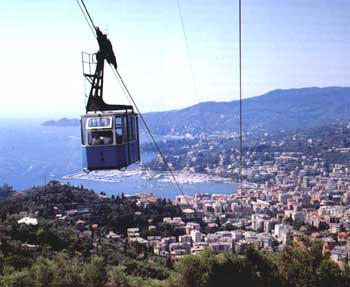
For the adventurous couple, take a cable car up to the Sanctuary of Our Lady of Montallegro, considered one of the most characteristic churches in Italy’s Liquria coast. A perfect adventure for your honeymoon or romantic vacation in the Cinque Terre.
The cable car offers a breathtaking ride up to the Neo-Gothic church with stunning views of Rapallo and as far as Portofino. The Sanctuary of Our Lady of Montallegro is nestled in the woods of the hills overlooking Rapallo and offers lovely picnic places, beautiful walks and a romantic adventure set to the backdrop of the Cinque Terre.
Legend has it that the Virgin Mary appeared to a farmer here, presenting him with a Greek-Byzantine icon and asked him to build a church to house it. Our Lady of Montallegro attracts numerous pilgrims as well as non-religious visitors and is a favorite destination for hikers exploring this part of the Italian Riviera.
The cable car is accessible a short distance from the Hotel Bristol in Rapallo, Italy. It is also possible to find your way to the Sanctuary of Our Lady of Montallegro via bus or a short up hill hike. Either way, this Neo-Gothic church is well worth a visit on your romantic vacation to the Cinque Terre.
The cable car offers a breathtaking ride up to the Neo-Gothic church with stunning views of Rapallo and as far as Portofino. The Sanctuary of Our Lady of Montallegro is nestled in the woods of the hills overlooking Rapallo and offers lovely picnic places, beautiful walks and a romantic adventure set to the backdrop of the Cinque Terre.
Legend has it that the Virgin Mary appeared to a farmer here, presenting him with a Greek-Byzantine icon and asked him to build a church to house it. Our Lady of Montallegro attracts numerous pilgrims as well as non-religious visitors and is a favorite destination for hikers exploring this part of the Italian Riviera.
The cable car is accessible a short distance from the Hotel Bristol in Rapallo, Italy. It is also possible to find your way to the Sanctuary of Our Lady of Montallegro via bus or a short up hill hike. Either way, this Neo-Gothic church is well worth a visit on your romantic vacation to the Cinque Terre.
Thursday, March 17, 2011
St Patricks Cathedral in Ireland
Feast your eyes and spirits on St. Patrick’s Cathedral in Dublin, Ireland. Built in honor of Ireland’s patron saint, there has been a church on the site since the 5th century. St. Patrick’s Cathedral is the largest church in Ireland with a 140 foot spire and is one of two Church of Ireland cathedrals.
It is said that St. Patrick’s story began here when he was baptized in a well close the cathedral’s location. Other sources say that St. Patrick baptized converts on his visit to Dublin.
Though a wooden structure was first built on the site; the present building dates from 1220. In the late 1800s a major rebuilding took place, explaining the Victorian styled decoration and architecture.
Breathtaking and immense; whether interested in the art and architecture or the historical significance, St Patrick’s Cathedral in Dublin, Ireland is well worth a visit. Today St. Patrick’s Cathedral is open to the public as an architectural and historical site, but principally as a place of worship. Visitors are charged a nominal fee.
This year, to mark Saint Patrick’s festival, St. Patrick’s Cathedral will be going green from March 16th through the 20th. The Cathedral will be bathed in green light every evening to honor Ireland’s national saint and will present all visitors with a sprig of Irish shamrock on St. Patrick’s Day.
Visit St. Patrick’s Cathedral on your next Celtic Tours Dublin Vacation. Start planning today!
It is said that St. Patrick’s story began here when he was baptized in a well close the cathedral’s location. Other sources say that St. Patrick baptized converts on his visit to Dublin.
Though a wooden structure was first built on the site; the present building dates from 1220. In the late 1800s a major rebuilding took place, explaining the Victorian styled decoration and architecture.
Breathtaking and immense; whether interested in the art and architecture or the historical significance, St Patrick’s Cathedral in Dublin, Ireland is well worth a visit. Today St. Patrick’s Cathedral is open to the public as an architectural and historical site, but principally as a place of worship. Visitors are charged a nominal fee.
This year, to mark Saint Patrick’s festival, St. Patrick’s Cathedral will be going green from March 16th through the 20th. The Cathedral will be bathed in green light every evening to honor Ireland’s national saint and will present all visitors with a sprig of Irish shamrock on St. Patrick’s Day.
Visit St. Patrick’s Cathedral on your next Celtic Tours Dublin Vacation. Start planning today!
Wednesday, December 29, 2010
Notre Dame de Paris
Notre Dame Cathedral in Paris is one of the best known Parisian landmarks, besides the Eiffel Tower. It is considered one of the finest examples of French Gothic architecture, characterized by the adoption of the pointed arch and invention of the flying buttresses to support the flamboyantly higher walls. Notre Dame de Paris was one of the first Gothic cathedrals, and its construction spanned the Gothic period. Its sculptures and stained glass show the heavy influence of naturalism, unlike that of earlier Romanesque architecture.The name of Notre Dame in French means “Our Lady”. In the sanctuary, leaning against the south east pillar of the transept, flowers which remain white honor a Virgin with Child dedicated to “Notre-Dame de Paris” Ever since the cathedral was first founded in the 12th century, an altar dedicated to the Virgin has stood on this spot.
Tradition has it that the first stone of Notre Dame was laid in 1163 in witness of Pope Alexander III. Construction continued throughout the entire Gothic period, with the remaining elements being completed in 1345. Attention to detail at its greatest, 182 years to build!
The organ of Notre Dame was first built in the 18th century and then almost completely rebuilt in the 19th century. The organ has 7,800 pipes, with 900 classified as historical. It has 111 stops, five 56-key manuals and a 32-key pedalboard.
There are five bells at Notre Dame. The great bourdon bell, Emmanuel, is located in the South Tower, weighs just over 13 tons, and is tolled to mark the hours of the day and for various occasions and services. There are four additional bells on wheels in the North Tower, which are swing chimed. These bells are rung for various services and festivals. The bells were once rung manually, but are currently rung by electric motors. When it was discovered that the size of the bells could cause the entire building to vibrate, which threatened its integrity they were taken out of use.
Whether you visit for the exquisite art and architecture or for the religious experience, when in France the Notre Dame Cathedral is not to be missed. Make it a stop on your Celtic Tours Experience France Tour of Paris and Nice. Our Experience France Tour is perfect for small groups of 10 or more. Learn more about this exciting France Vacation.
Tuesday, August 24, 2010
Gallarus Oratory: A Masterpiece of Simple Architecture
The Gallarus Oratory is a masterpiece of simple architecture. It was built by local farmers as a place of worship. This historic church is believed to date back to the 6th century. Simple architecture built only of local stones fitted carefully together, using no mortar.
The Gallarus Oratory is in an excellent state of repair despite the fact that it hasn’t been restored. This perfect example of a dry stone building style has withstood the formidable Atlantic elements for over 1200 years! Additionally, this remarkable structure withstood, like most of Ireland, attacks by successive invaders. Vikings and Anglo-Normans burned, pillaged and destroyed the settlements around Gallarus.
The Gallarus Oratory is shaped like an upturned boat. There is no separate roof, but only walls that meet on top. There is just one door and one tiny window.
The Gallarus Oratory is situated at the south eastern corner of Smerwick Harbour on the Dingle Peninsula. And is well worth the stop!
![]() |
| Gallarus Oratory, Dingle Peninsula, Ireland |
The Gallarus Oratory is in an excellent state of repair despite the fact that it hasn’t been restored. This perfect example of a dry stone building style has withstood the formidable Atlantic elements for over 1200 years! Additionally, this remarkable structure withstood, like most of Ireland, attacks by successive invaders. Vikings and Anglo-Normans burned, pillaged and destroyed the settlements around Gallarus.
![]() |
| Inside the Gallarus Oratory, Dingle Peninsula, Ireland |
The Gallarus Oratory is situated at the south eastern corner of Smerwick Harbour on the Dingle Peninsula. And is well worth the stop!
Friday, July 16, 2010
Aran Islands, Ireland

The rugged and barren landscapes of the Aran Islands, dotted with thatched roof stone cottages, Early Christian churches and ancient stone forts offer one of the best glimpses of the traditional Irish way of life. The everyday language of the Islanders is Gaelic, and their songs and stories illustrate and preserve much of Ireland’s folklore and culture.
Three islands: Inishmore, Inishmaan and Inisheer, make up the legendary Aran Islands off the west coast of Galway. The rugged landscape made it tough for the islanders. However, they adapted themselves to the raw climatic conditions, developing a survival system of total self-sufficiency. Their methods included mixing layers of sand and seaweed on top of rocks to create fer
tile soil, a technique used to grow potatoes and other vegetables. The same seaweed method also provided grazing grass within stone-wall enclosures for cattle and sheep, which in turn provided wool and yarn to make hand-knitted goods for which they are famous for. The islanders also constructed unique boats made of laths and tarred canvas for fishing.
Many Irish saints had some connection with Aran: St. Brendan was blessed for his voyage there; Jarlath of Tuam, Finnian of Clonard, and St. Columba called it the "Sun of the West." Writers and artists alike have also been
inspired by the landscape. Playwright JM Synge commemorates the island’s sturdy fisherfolk is “Riders to the Sea” and “The Aran Islands”. The life of this traditional Irish community has also been portrayed in the film “Man of Aran”.
Whether exploring the depths of the traditional Irish life, intrigued by early Christian structures, studying ancient stone fortresses or just looking for a bit of inspiration by the beautiful landscape; the Aran Islands are the perfect way to compliment your Irish vacation.
Three islands: Inishmore, Inishmaan and Inisheer, make up the legendary Aran Islands off the west coast of Galway. The rugged landscape made it tough for the islanders. However, they adapted themselves to the raw climatic conditions, developing a survival system of total self-sufficiency. Their methods included mixing layers of sand and seaweed on top of rocks to create fer
tile soil, a technique used to grow potatoes and other vegetables. The same seaweed method also provided grazing grass within stone-wall enclosures for cattle and sheep, which in turn provided wool and yarn to make hand-knitted goods for which they are famous for. The islanders also constructed unique boats made of laths and tarred canvas for fishing.Many Irish saints had some connection with Aran: St. Brendan was blessed for his voyage there; Jarlath of Tuam, Finnian of Clonard, and St. Columba called it the "Sun of the West." Writers and artists alike have also been
inspired by the landscape. Playwright JM Synge commemorates the island’s sturdy fisherfolk is “Riders to the Sea” and “The Aran Islands”. The life of this traditional Irish community has also been portrayed in the film “Man of Aran”.Whether exploring the depths of the traditional Irish life, intrigued by early Christian structures, studying ancient stone fortresses or just looking for a bit of inspiration by the beautiful landscape; the Aran Islands are the perfect way to compliment your Irish vacation.
Subscribe to:
Posts (Atom)