Travel blog about European travels to Ireland, Scotland, England, Italy, Switzerland, Austria, Germany, France and more!
Tuesday, September 14, 2010
Bunratty Castle & Folk Park
The most complete and authentically restored and furnished castle in Ireland, a colorful folk park and the famous Bunratty Castle Medieval Banquets. This is one tourist attraction you are not going to want to miss!
Bunratty Castle, North Munster, is sited on an original Viking Trading Camp which dates back to around 970 and is the last of four castles to be built on the site. The present castle was built in 1425 by the McNamara family and remained in their possession until 1475. In the 17th Century the castle was the palace of the Earls of Thomond and was surrounded by gardens and a great deer park. The castle passed through many hands before falling into disrepair. In 1954, Lord Gort purchased the estate and returned it to its former glory. It is now the most complete and authentically restored and furnished castle in Ireland and it has been open to the public since 1960.
Bunratty Castle is a large tower house, a particular type of stone structure, built for defensive purposes as well as habitation. Tower houses appeared since the Middle Ages, especially in mountain or limited access areas, in order to command and defend strategic points with reduced forces. At the same time, they were also used as a noble's residence, around which a borough was often constructed.
Alongside the Castle is an extensive folk park, particularly popular with families, tourists and schools. The Folk Park is a colorful illustration of Irish life in the 19th and early 20th Centuries. Buildings range from the landlord’s house to the smallest peasant cottage, along with an assortment of village shops, a smithy, two watermills and an excellent collection of old farm implements. There are live demonstrations of bread baking, weaving and pottery making. The 19th century walled garden has been re-created to grow fruit, vegetable and flowers as it did when it was the source of supply to Bunratty Castle.
The famous Bunratty Castle Medieval Banquets were first held in the early 1960s and the event has grown stronger ever since. This is a dinner experience not to be missed! Each night the Ladies of the Castle, aided and abetted by the Earl of Thomond’s Butler, welcome guests from the four corners of the globe to dine at The Earl’s Banquet at Bunratty Castle. The entertainment provided by the world renowned entertainers is a fitting compliment to a mead reception in the Great Hall of the castle, a four course traditional feast and of course good wine.
If it’s Medieval Ireland you are interested in, the Bunratty Medieval Banquet is not to be missed. You can add the Banquet onto any Celtic Tours package to Ireland for $89 PP, entertainment and 4 course meal included. Learn more about Celtic Tours Ireland Packages.
Monday, September 13, 2010
Dublin City Hall
Amazing history and impressive architecture: 1000 years of Dublin history contained under the atmospheric vaults of Dublin City Hall. Adjacent to Dublin Castle, Dublin’s City Hall has been the site of major historical events. Most notably, Easter 1916, Dublin City Hall was occupied by the rebel forces.
Originally erected in the late 1700’s, Dublin’s City Hall was formerly the Royal Exchange. The Exchange was a place where the business men of Dublin could buy and sell goods and then trade Bills of exchange. As it was close to the Customs House, it was handy for traders and merchants, landing in Dublin from overseas.
The neo-classical building contains a central entrance hall or Rotunda, with a large dome supported by twelve columns which is surrounded by an ambulatory where the merchants strolled and discussed business meetings. Dublin City Council have owned the building since 1851 and have recently restored it to its original beauty.
“The Story of the Capital” Exhibition in the atmospheric vaults of Dublin City Hall, is an exciting multimedia exhibition which traces the history of Dublin City. It tells of the city’s founding, through Viking times and into the unique and vibrant city today. Treasures of the city such as the Great Sword and mace of Dublin and the Lord Mayor's chains come together with video, medieval manuscripts, interactive computer displays and period costumes, to tell the story of the capital city.
For those who want to know a bit about the history of Dublin, the exhibition takes just one hour and tells over 1000 years of the history of this unique and ever changing city. From trade to war, Dublin has had a colorful past. Learn all about it at Dublin's City Hall on your next Ireland Vacation with Celtic Tours.
Dublin City Hall
Lord Edward St.
Dublin 8
Ireland
Originally erected in the late 1700’s, Dublin’s City Hall was formerly the Royal Exchange. The Exchange was a place where the business men of Dublin could buy and sell goods and then trade Bills of exchange. As it was close to the Customs House, it was handy for traders and merchants, landing in Dublin from overseas.
The neo-classical building contains a central entrance hall or Rotunda, with a large dome supported by twelve columns which is surrounded by an ambulatory where the merchants strolled and discussed business meetings. Dublin City Council have owned the building since 1851 and have recently restored it to its original beauty.“The Story of the Capital” Exhibition in the atmospheric vaults of Dublin City Hall, is an exciting multimedia exhibition which traces the history of Dublin City. It tells of the city’s founding, through Viking times and into the unique and vibrant city today. Treasures of the city such as the Great Sword and mace of Dublin and the Lord Mayor's chains come together with video, medieval manuscripts, interactive computer displays and period costumes, to tell the story of the capital city.
For those who want to know a bit about the history of Dublin, the exhibition takes just one hour and tells over 1000 years of the history of this unique and ever changing city. From trade to war, Dublin has had a colorful past. Learn all about it at Dublin's City Hall on your next Ireland Vacation with Celtic Tours.
Dublin City Hall
Lord Edward St.
Dublin 8
Ireland
Friday, September 10, 2010
James Joyce Museum
![]() |
| Statue of James Joyce on North Earl Street, Dublin |
James Joyce was a literary giant, considered one of the most influential writers of the 20th century. Joyce, along with others, was a key figure in the development of the modernist novel. Though most of Joyce's adult life was spent in continental Europe, his fictional universe does not extend much beyond Dublin, and is populated largely by characters who closely resemble family members, enemies and friends from his time there; Ulysses in particular is set in the real streets and alleyways of the city.
Joyce’s major works include: Dubliners, A Portrait of the Artist as a Young Man, Exiles and Poetry, Finnegan’s Wake and Ulysses. Joyce's Ulysses is a novel of eighteen "episodes," all set in Dublin, Ireland, between 8:00 a.m. and 3:00 am, June 16-17, 1904. The three main characters are a young school teacher and aspiring writer named Stephen Dedalus (the main character of A Portrait of the Artist as a Young Man), a middle-aged Jewish advertising salesman named Leopold Bloom, and Leopold's wife, Molly Bloom. The plot and theme of James Joyce's Ulysses center on life as a journey. Joyce based the framework of his novel on the structure of one of the greatest and most influential works in world literature, The Odyssey, by Homer.
The work and life of Joyce is celebrated annually on 16 June, Bloomsday, in Dublin and in an increasing number of cities worldwide.
The James Joyce Museum is just a short walk from Dun Laoghaire, in Sandycove, South County Dublin, in Martello Tower, which was originally built by the British as a defense against the expected Napoleonic invasion. The museum houses a large collection of Joyce memorabilia including letters, photographs, first and rare editions and personal possessions of Joyce, as well as items associated with the Dublin of Ulysses.
Visit The James Joyce Museum on your Celtic Tours City Stay. Learn more about Dublin City Stays with Celtic Tours.
Thursday, September 9, 2010
Trinity College & The Book of Kells
Trinity College is famed for its great treasures including the Book of Kells, a 9th Century illuminated manuscript, the Books of Durrow and Armagh and an early Irish harp. The 690 page Book of Kells is the centerpiece of the “Turning Darkness into Light” exhibition which attracts over 500,000 visitors to Trinity College every year. Written around 800 AD, the Book of Kells contains a richly decorated copy of the four gospels in a latin text, written on vellum (prepared calfskin). The script is embellished by the elaboration of key words and phrases and by an endlessly inventive range of decorated initials and interlinear drawings. This massive book was originally a single volume, but was rebounded into four volumes in 1953 for conservation reasons.
The illustrations and ornamentation of the Book of Kells surpass that of other Insular Gospel books in extravagance and complexity. The decoration combines traditional Christian iconography with the ornate swirling motifs typical of Insular art. Figures of humans, animals and mythical beasts, together with Celtic knots and interlacing patterns in vibrant colours, enliven the manuscript's pages. Many of these minor decorative elements are imbued with Christian symbolism and so further emphasise the themes of the major illustrations.The origin of the Book of Kells is generally attributed to the scriptorium of the monastery founded around 561 on Iona, an island off the west coast of Scotland. In 806, following a Viking raid on the island, the Columban monks took refuge in a new monastery at Kells, County Meath. The Book of Kells has been on display at Trinity College in Dublin from the mid 19th century.
Trinity College was founded in 1592 by Queen Elizabeth and today is recognized internationally as Ireland’s premier university and is 43rd position in the top 100 world universities. The College builds on its 400 year old tradition of scholarship to confirm its position as one the great universities of the world, producing many famous graduates over the centuries such as Edmund Burke and Oliver Goldsmith. Located in the heart of Ireland’s capital on its 40-acre site, Trinity College retains some of its ancient seclusion of cobbled squares, gardens and parks.

Trinity College and the Book of Kells is a featured stop on Celtic Tours Celtic Dream Premier Escorted Motorcoach Tour of Ireland. Learn More
Wednesday, September 8, 2010
The Doors of Dublin
The colorful Doors of Dublin are a steadfast tribute to individuality. Forced to adhere to the strict Georgian style and architectural guidelines, the former Georgian Dublin residents painted their front doors whatever color they fancied, added ornate knockers, elegant fanlights above the door and wrought iron boot scrapers near the entrance. Where once, these doors were all the same color, they became a festive array of colors setting their selves apart.
Of course there are several colorful stories behind the colorful doors that are found on the Georgian town houses south of the Liffey and are an established visual attraction in the capital. Dublin’s equally as famous Georgian Squares were laid out during the Hanoverian period in the 1700s as the city attracted new wealth and rejuvenation.
Before then, Dublin was considered no more than a provincial town in the British Empire, but from about 1715, anti-catholic penal laws were relaxed, which allowed many middle-class Catholics to establish themselves in trade.
At the time, Dublin was ruled by members of a Protestant upper class, descendants of English invaders from Norman, Elizabethan and Cromwellian times. Known as the Protestant Ascendancy these settlers began to push for reforms, better conditions and rights for Catholics and for greater autonomy for the Irish Parliament. Dublin’s Protestants began to build their elegant new Georgian homes beyond the walls of the medieval town.
From the 1950’s onwards, these Georgian homes along with their colorful doors were seen as a relic to Ireland’s colonial past and were destroyed to make way for utilitarian office blocks and government departments. Tourists and the infamous poster “The Doors of Dublin” saved these buildings from certain annihilation.
“The Doors of Dublin” poster was collaged by Bob Fearon, head of an ad agency in NYC who had been in Dublin on a commercial shoot. Struck by the symmetry and beauty of the Georgian doorways, he took photos of forty or more of them for a personal project. Upon completion of the collage, he showed it to Joe Malone, North American Manager of the Bord Failte at the time, who thought it would be perfect for his Irish Tourism office display window on St. Patrick’s Day. The Irish Tourist Board thought so too and bought the rights to the collage. In turn, the Irish Government began to wake up to the rich potential of tourists with their cameras who were drawn like magnets to the squares and halted destruction of these famous buildings. The end result was a poster which became a history-making award winner all over the world.
Experience the history behind the array of colorful doors on a self guided tour of Dublin with Celtic Tours. Learn more about our Dublin Vacations.
Of course there are several colorful stories behind the colorful doors that are found on the Georgian town houses south of the Liffey and are an established visual attraction in the capital. Dublin’s equally as famous Georgian Squares were laid out during the Hanoverian period in the 1700s as the city attracted new wealth and rejuvenation.
Before then, Dublin was considered no more than a provincial town in the British Empire, but from about 1715, anti-catholic penal laws were relaxed, which allowed many middle-class Catholics to establish themselves in trade.
At the time, Dublin was ruled by members of a Protestant upper class, descendants of English invaders from Norman, Elizabethan and Cromwellian times. Known as the Protestant Ascendancy these settlers began to push for reforms, better conditions and rights for Catholics and for greater autonomy for the Irish Parliament. Dublin’s Protestants began to build their elegant new Georgian homes beyond the walls of the medieval town.
From the 1950’s onwards, these Georgian homes along with their colorful doors were seen as a relic to Ireland’s colonial past and were destroyed to make way for utilitarian office blocks and government departments. Tourists and the infamous poster “The Doors of Dublin” saved these buildings from certain annihilation.
“The Doors of Dublin” poster was collaged by Bob Fearon, head of an ad agency in NYC who had been in Dublin on a commercial shoot. Struck by the symmetry and beauty of the Georgian doorways, he took photos of forty or more of them for a personal project. Upon completion of the collage, he showed it to Joe Malone, North American Manager of the Bord Failte at the time, who thought it would be perfect for his Irish Tourism office display window on St. Patrick’s Day. The Irish Tourist Board thought so too and bought the rights to the collage. In turn, the Irish Government began to wake up to the rich potential of tourists with their cameras who were drawn like magnets to the squares and halted destruction of these famous buildings. The end result was a poster which became a history-making award winner all over the world.
Experience the history behind the array of colorful doors on a self guided tour of Dublin with Celtic Tours. Learn more about our Dublin Vacations.
Thursday, September 2, 2010
Ha'Penny Bridge: Dublin, Ireland
Although there are over 20 bridges crossing the River Liffey, none are as popular as the Ha’Penny Bridge. The Ha’Penny Bridge is a pedestrian only bridge over the River Liffey in Dublin, Ireland, providing a great shortcut from the Temple Bar to the North Quays. Though the official name is the Liffey Bridge, it is commonly referred to as the Ha’Penny Bridge because anyone crossing was charged a toll of a half penny. The toll was dropped in 1919, and visitors are free to cross.
Before the Ha’Penny Bridge was built, the only way to cross the River Liffey was by ferry. These ferries were operated by a William Walsh, and were in bad condition. Walsh was informed that he had to either fix them or build a bridge. Walsh opted to build a bridge. The bridge was built in 1816 of cast iron.
It is estimated that over 20,000 people cross the bridge daily. Though most people are on their way to or from work, tourists will find themselves crossing it at least once during their visit.
The Ha’Penny Bridge was recently restored to include period lanterns. The bridge is lit up at night, providing a pretty scene against the dark water of the river. Considered one of the most photographed structures in Dublin, it is a big draw. For all those who want to include a bit of Dublin history in their pictures, the Ha’Penny Bridge is a must photo-op!
Before the Ha’Penny Bridge was built, the only way to cross the River Liffey was by ferry. These ferries were operated by a William Walsh, and were in bad condition. Walsh was informed that he had to either fix them or build a bridge. Walsh opted to build a bridge. The bridge was built in 1816 of cast iron.
It is estimated that over 20,000 people cross the bridge daily. Though most people are on their way to or from work, tourists will find themselves crossing it at least once during their visit.
The Ha’Penny Bridge was recently restored to include period lanterns. The bridge is lit up at night, providing a pretty scene against the dark water of the river. Considered one of the most photographed structures in Dublin, it is a big draw. For all those who want to include a bit of Dublin history in their pictures, the Ha’Penny Bridge is a must photo-op!
Wednesday, September 1, 2010
Kilmainham Gaol
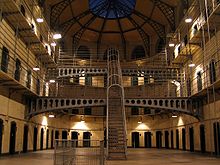
The Kilmainham Gaol is a former prison, located in Kilmainhamin Dublin, which is now a museum. Steeped in Irish history, the Gaol pays tribute to the historic importance of the men and women who were held or died here for their nationalist ideals.
The Kilmainham Gaol offers a panoramic insight into some of the most profound, disturbing and inspirational themes of modern Irish history. Giving the visitor a dramatic and realistic insight into the conditions of those confined here during the 128 years that it served as a prison. When the Gaol was first built, public hangings took place at the front of the Gaol. This practice was mollified in the 1820’s when fewer hangings took place at Kilmainham.
Conditions were poor at best. Prisoners spent most of their time in the cold and dark, given only 1 candle for light and heat. With cells holding up to 5 prisoners: men, women and children, the candle was to last two weeks. Children were sometimes arrested for petty theft, the youngest said to be a seven year old boy, while many of the adult prisoners were deported to Australia.
Over the 128 tenure, the Kilmainham Gaol’s cells held many of the most famous people involved in the campaign for Irish independence. The British imprisoned and executed the leaders of the 1916 Easter Rising here. Such names as Robert Emmet and Charles Stewart Parnell are associated with the Gaol.
Kilmainham Gaol was closed as a prison in 1924, by the government of the new Irish Free State. Following lengthy restoration, it now houses a museum on the history of Irish nationalism, offering guided tours of the building. An art gallery on the top floor exhibits paintings, sculptures and jewelry of prisoners incarcerated in prisons all over contemporary Ireland.
The Kilmainham Gaol is a featured stop on Celtic Tours premier escorted motorcoach tour the Celtic Dream. This amazing itinerary is available in 2 options: 12 or 13 days! Other sights you will see along the way: Trinity College and the Book of Kells, Kilkenny Castle, Cobh Heritage Center, Blarney, Foynes Flying Boat Musuem, Cliffs of Moher, Rathbaun Farm, Galway Crystal Factory, Belleek Pottery Factory, Glenveagh Castle and National Park, Fort Dunree, Moville Pottery, Giants Causeway, Titanic Docks & Pumphouse…Wow, what an amazing Celtic Dream. Learn More about this tour.
Kilmainham Gaol
Inchicore Road,
Kilmainham,
Dublin City Area South,
Dublin,
Republic of Ireland
The Kilmainham Gaol offers a panoramic insight into some of the most profound, disturbing and inspirational themes of modern Irish history. Giving the visitor a dramatic and realistic insight into the conditions of those confined here during the 128 years that it served as a prison. When the Gaol was first built, public hangings took place at the front of the Gaol. This practice was mollified in the 1820’s when fewer hangings took place at Kilmainham.
Conditions were poor at best. Prisoners spent most of their time in the cold and dark, given only 1 candle for light and heat. With cells holding up to 5 prisoners: men, women and children, the candle was to last two weeks. Children were sometimes arrested for petty theft, the youngest said to be a seven year old boy, while many of the adult prisoners were deported to Australia.
Over the 128 tenure, the Kilmainham Gaol’s cells held many of the most famous people involved in the campaign for Irish independence. The British imprisoned and executed the leaders of the 1916 Easter Rising here. Such names as Robert Emmet and Charles Stewart Parnell are associated with the Gaol.
Kilmainham Gaol was closed as a prison in 1924, by the government of the new Irish Free State. Following lengthy restoration, it now houses a museum on the history of Irish nationalism, offering guided tours of the building. An art gallery on the top floor exhibits paintings, sculptures and jewelry of prisoners incarcerated in prisons all over contemporary Ireland.
The Kilmainham Gaol is a featured stop on Celtic Tours premier escorted motorcoach tour the Celtic Dream. This amazing itinerary is available in 2 options: 12 or 13 days! Other sights you will see along the way: Trinity College and the Book of Kells, Kilkenny Castle, Cobh Heritage Center, Blarney, Foynes Flying Boat Musuem, Cliffs of Moher, Rathbaun Farm, Galway Crystal Factory, Belleek Pottery Factory, Glenveagh Castle and National Park, Fort Dunree, Moville Pottery, Giants Causeway, Titanic Docks & Pumphouse…Wow, what an amazing Celtic Dream. Learn More about this tour.
Kilmainham Gaol
Inchicore Road,
Kilmainham,
Dublin City Area South,
Dublin,
Republic of Ireland
Subscribe to:
Posts (Atom)